2021 Blooming Hill Events and Happenings

We are working on it. Stay tuned...

Monday, July 29, 2013

Some Snippets of Lavender, Please


So, I thought I might take a page from my friend, Karen (Spokalulu), who is a serial blogger and make this particular blog entry the first in a series about the different varieties that I grow. Although I'm not promising that I'll talk about all 60+ varieties, in the next 4 or 5 weeks ('cause that might put you  to sleep), I'll go through quite a few of them and I'll start it off today with three of my "top picks" for the 2013 season.  These "picks", so to speak, are varieties that I have here at the farmlet to sell and now, as we are deep into high summer and will soon round the final bend in the road toward early autumn, almost all of these babies have gone home to live with a new family.  Sounds a little like a pound puppy going home to live with it's new rescue family, doesn't it? Well, I can't help it if I get a little emotional when I think about lavender.


              So, here goes, the first in a series on different lavenders and not in any particular order...

The first variety is 'Hidcote' one of the most beautiful and popular lavenders out there. It is often used for culinary purposes as well since it's fragrance is citrucy sweet. Sounds like the "can-do-anything" daughter who became the captain of the varsity cheerleading squad--something I never aspired to be, nor was talented enough to even think about achieving.  'Hidcote Blue', now often just called 'Hidcote', is a Lavandula angustifolia, typically referred to as an English lavender in this country, although lavender did not originate in England--surprised you, didn't I?! Petite and pretty 'Hidcote' is sort of the Grande Dame of the lavender world.  The rich, dark purple-blue colored flower heads atop true green foliage have made it a very popular plant since its introduction, way back in the early 1920's, by Hidcote Manor in England, although it was originally propagated in France. Nowadays, since 'Hidcote' has been so popular, it is often propagated from seed, making it not original to the plant so, it can be hard to find the real 'Hidcote'  In order to get an exact copy of it's parent, a lavender must be propagated from by a cutting from the original plant also called cloning.

Next up, another Lavandula angustifolia, called 'Munstead.'  Before there was 'Hidcote' there was her dependable, older sister, 'Munstead', made famous by Gertrude Jekyll, an early 1900's Landscape Designer of West Surrey, England, where she grew lavender on her estate, Munstead Wood.  Another one of those heirloom lavenders that has been so over-propagated by many growers through the years that it is also hard to find real 'Munstead.'  Athough I do have real Munstead in my collection of lavenders and I have propagated it from cuttings in the past, this year, I tried growing it from seed and it is a pretty impostor.  However, 'Munstead grown this way should really be referred to as 'Compacta'. For simplicity's sake, we will stay with the name Munstead and, that's also what the packet of seeds incorrectly called it, too.  It's flowers are a nice purple, not quite as vivid as 'Hidcote.' but dependably hardy with a floppier and messier habit, in the garden.  In my opinion, between the two, 'Hidcote' was the sister who got to wear the dress while 'Munstead' was the sister who stayed home.

Now, let me throw in what is commonly referred to as a "French" lavender from the family (species) of Lavandula x intermedia.  People often say to me, "I only want French lavender."...Sighhhhh. Maybe a little bit of a history lesson about lavender will help you better understand where I am coming from. Lavender's origin probably stems from somewhere in the Middle East as it is sighted in the Bible and it is also documented in Arabic cookbooks as early as the 12th Century.  From there, lavender traveled to Greece and then to islands off of the southern coast of France and then finally to mainland Europe, starting in France, Italy and Spain. Technically, I guess you could say that all lavenders are in some way French.  It just depends on what you really mean.   In the U.S.A Lavandula x intermedia's (sterile hybrids that can only be propagated through cuttings) are often referred to as French and are also called lavendins which is a more accurate term for them.

'Gros Bleu' (Lavandula x intermedia) is one of my absolute favorites having been a resident in my gardens for about five years now.  It's long, graceful stems and almost electric blue flower heads on top of silvery foliage make this variety a real showstopper here at Blooming Hill even though it is not one of the most prolific of bloomers.  It also has a clean lavender scent that is not overpowering but fresh.  'Gros Bleu' is one of the very last lavenders to bloom, when established, extending the lavender season into the last days of July, here in Northern Virginia.  Another little tidbit here--although intermedias, as a group, are not typically thought of as culinary lavenders, this one can be used as its fragrance is not as piney and camphorous as other lavendins.


All done with installment number one!  I hope you found this to be a little informative.  And, yes, I know I was even more long winded than usual, so I'll try to be a little more brief in future episodes. Is there a variety of lavender in your yard that you might be wondering about?  I'm happy to help you learn a little more about it.  Chances are pretty good that it might be one I also have in my collection. Next week, I'll talk about pink lavender varieties.  Stay tuned...

(Note:  My descriptions of lavenders are based purely on my observations of their performance in my own gardens and with the help of a little research, here and there through the years, to boot.  I do not claim to be an expert on lavender, just a gardener who has had a particular interest and love for this plant commonly referred to as lavender for the last 20 years.  I consider the lavenders in my gardens a collection I'm fortunate to have and will continue collecting them through the coming years as long as we have room for them to grace the gardens here at Blooming Hill.)


Friday, July 12, 2013

Lavender Wands--Pieces of July

Evening vespers among the lavender.
Rafters filled with dried lavender bundles.
July is the month to celebrate lavender here at Blooming Hill and, it is also the herb of the month, named by The Herb Society of America.  The harvest is in and although it is just high summer, twilight seems to be already drifting ever-so-quietly over the field and the gleaming sun that coaxed the purple and violet buds out of their tightly wrapped green cloaks, during the month of June, is beginning to set ever-so-slightly in the west as the world spins onward. But, the magic and allure of lavender does not stop with the harvest, oh no.  While life goes on, we can sit back and take stock in a job well done and be thankful for a good season and bountiful crop and maybe wax a little nostalgic, especially when making lavender wands.

The beginning of a lavender wand.
Weaving a wand can be a dizzying experience.
Freshly finished wands.
Victorians were the clever ones who came up with this elegant idea of weaving the frilly fragrant flower heads atop their stately, long stems together with colorful ribbon and fashioned them into a wand, of sorts. Lavender wands, or some may refer to them as lavender bottles, can be big or small, but all can lend their fragrance and calming beauty to sweet dreams on a bedside table, easing a headache, or just perfuming a closet or drawer. When given as a gift, lavender wands can convey the feeling of gentle devotion to another and are often seen gracing wedding party tables. The late 19th and early 20th Century author, Myrtle Reed, wrote, "I've always thought my flowers had souls," in her book, Lavender and Old Lace.  I have come to realize that a lavender wand is a charming expression of it's soul, whimsical yet graceful at the same time.

'Seal' lavender (Lavandula x intermedia).
The crew is happy to be finished and there is never a question as to who gets to ride 'shot gun'.
I still have a few bushes of Seal (Lav. x intermedia) lavender, a long stemmed variety, left purposely uncut so I can make these fairy-like wands and I love the colorful ribbons I use to weave their magic.  I can breathe in the grassy high notes that are intermingled with the citrusy middle and piney bottom notes of lavender all bound together in a simple rainbow of satin.

For a simply elegant experience, just wave your lavender wand and find yourself magically transported back to a summer day in the month of July, any time of the year.
Lavender wands need to be made with freshly cut lavender as the stems should be pliable enough to bend without breaking and for those of us with two left hands and all thumbs, (like me, for instance, since I am left-handed to begin with and could never really master the art of knitting or crochet) weaving lavender wands is a nature-inspired way to create a piece of "Victorian folk art," if that is such a thing, and keep the best pieces of summer close to your heart for several years.


Friday, June 28, 2013

U-Pick Lavender at Blooming Hill

We have had such a great spring that lavender is blooming up all over the place here at Blooming Hill...Hey, maybe that's we call ourselves Blooming Hill!!  U-Pick lavender starts today, June 28 and will go into July Fridays and Saturdays while supply lasts.  We have 'Grosso', 'Provence' and 'Royal Purple' varieties ready for you to pick and ribbon up yourself.  'Provence' and 'Royal Purple' are culinary varieties, as well.  Come and enjoy the beautiful day and pretty gardens and hum along with the bees as they flit from stem to stem.  Just don't grab one of those bees...they really don't care for that!...Trust me, I know from where I speak.

Anyway, make a (or several, whatever you prefer) bouquet by filling up a Ball Jar for $12.00.  Minus the Ball Jar, of course...sorry...they are supplied here to assist you in making your bundle of lavender, approximately 150 stems, the prettiest it can be.  If you don't want to pick that lavender, we have freshly picked bundles all ready to go as well.  Stop by.

Monday, June 17, 2013

The Colors of the Season--What's Trending (Growing) Now

Red Rose and Sun Drop hosiery compliment flow blue high heels.
It's Fashion Week here in the Blooming Hill Gardens.  Come to think of it, every week is fashion week here from early spring to frost.  Okay, okay--it may not be exactly what we all think of when it comes to fashion week but the warmer months, especially June, bring out the season's brights, pastels, prints and textures that rival even the best of the couture designer's ideas.  Perhaps, because designers often rely on Mother Nature for inspiration, especially when it comes to color and style.

African Daisies are never posers!
Although the buzz around Blooming Hill by those in the know, so to speak, is all about the color lavender.  It's the reason for the season, the icing on the cake, the bees knees, (ohhhhh, you know what I mean) and, the Grande Dame is just about to make her appearance here.  So, naturally, there many other flowers who want to take advantage of center stage before her entrance into summer and some even dress in the chosen color, too!  And, why wouldn't they?!  It's the color of royalty, rich and deep and, the crowning glory to my gardens.


Pretty striped petunias make a wide-brimmed sun hat.
'Crystal Palace Gem' Garden Geranium wrap the statuary  in style.
Asiatic Lilies flaunt themselves in orange.  What's old is new again.  
Blushing begonias.
Butterfly Weed for only the most discerning of fluttery creatures. 
A zesty and sassy Nasturtium blossom.
Subtle Sea Holly.
 Rose Campion atop silver-fringed stems.
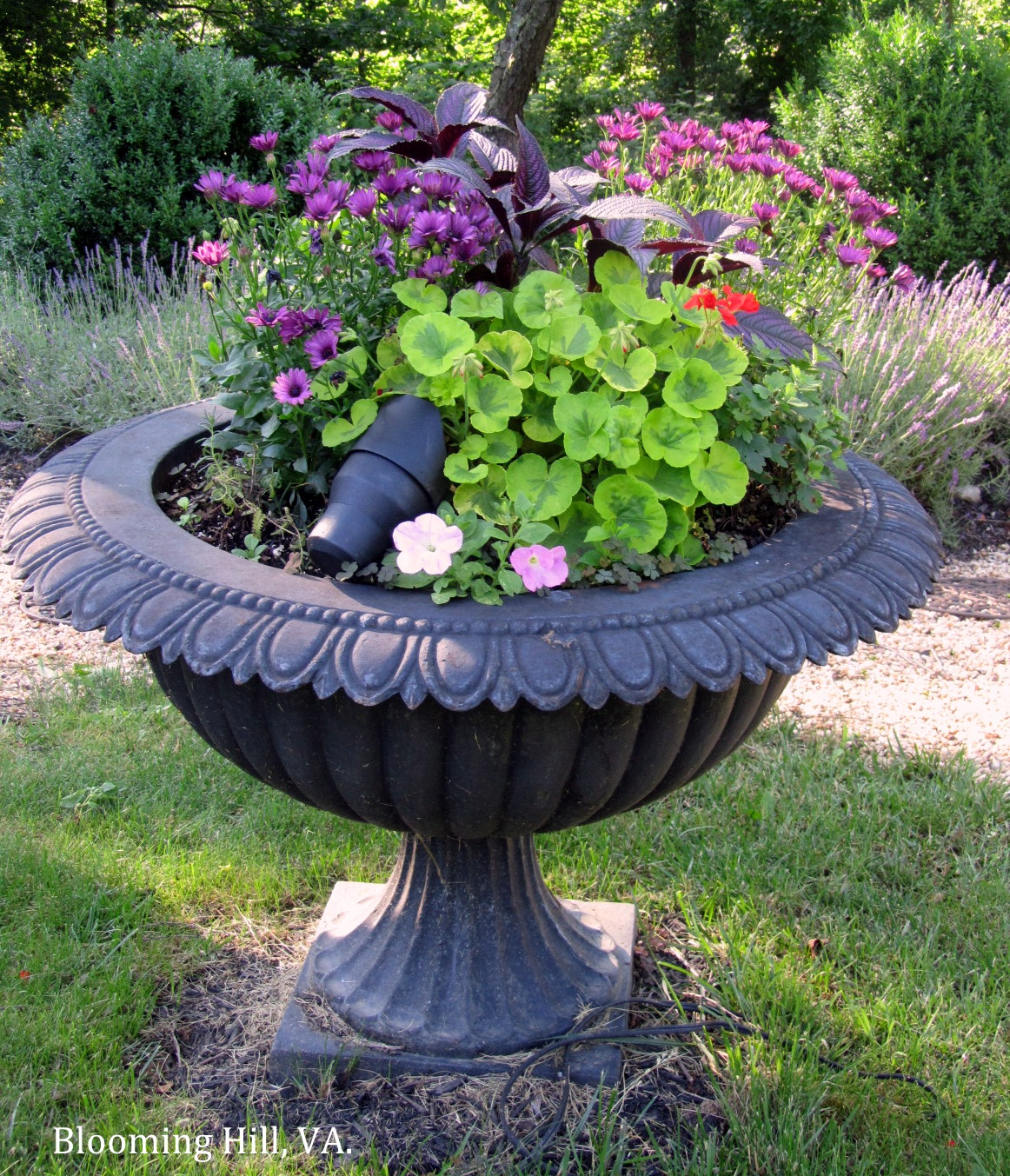
An urn all decked out for the media.
Madame Mandevilla, I presume.
Pale pink 'Melissa' lavender beginning to make her entrance, not wanting to miss a thing and fit for  a bridal bouquet. Oh my!
 Petite Lobelia paisley-shaped petals.
Dahlias for day into evening.
Oakleaf hydrangea for the office.
Guara, great for weekend wear.
 Daylilies and Coreopsis whisper together while peaking through the crowd.
Martha Washington geraniums can always dress up a garden party.
Brilliant, tiny Brachyscome.
Youthful, dewy Sun Drops emerge twirl in their emerald green petticoats!


Uh, oh! Here come the lavender brides, at last!


There is so much more to the floral fashions of summertime-- kissed by the sun, coiffed by raindrops and fluffed by soft breezes highlighting the colors and patterns of what is trending (growing) now at the outdoor showrooms of Blooming Hill. Everyday brings new fashions to the show designed by Mother Nature, herself.  What's debuting in your garden runways?


Sunday, June 2, 2013

We Are Not Alone!

Last week, my friend Kim, sent me an article about the appearance of Garden Gnomes as decorations at the 100th Anniversary of the Chelsea Flower Show in England.  The article, published in the New York Times, talked about how many British gardeners (I'm sure they consider themselves gardening purists at heart) were shocked and horrified that something as silly as a simple garden gnome could be allowed in such a sophisticated and historical event, while other Brits were glad to see a little whimsy and good humor finally make their debut into the stiff, upper-crust crowning glory of the British gardening world.  It's hard to believe that garden gnomes seem to have no place in the traditional English garden when the country itself is steeped with legend and lore about creatures such as these.  You know--like fairies and elves and leprechauns.

Gnome Ranger and his trusty frog.
Gnome Rider and his dependable turtle.
According to some, the gnome is often said to be the actual caretaker of any garden it inhabits, helping out with at least some of the smaller garden chores, once the lights of the house have gone out and everyone has gone to bed. I'm pretty sure we have all experienced a plant or two placed thoughtfully in the dirt without our assistance while more than a few weeds somehow got pulled when we were not looking and, quite frankly, I'm glad for the help mystical, whimsical or just plain practical.  Gnomes are said to enhance the harvest and help any and all creatures, great and small, that live in the garden.

An acorn-capped  happy little elfish gnome.
In any case, whether you believe or not, in the existence of gnomes, fairies and other mythical folk who mysteriously move around in the garden at night or in the day--things/movements that we see from the corner of our eye for a fleeting moment--we cannot deny the beauty of a garden and it's attraction of all things magical.  According to legend, gnomes are woodland creatures that represent the spirit of the earth.  They are said to bring good luck to the garden and the gardener who invites them in.

Next year, the Chelsea Flower Show will revert back to it's No-Gnome policy--at least no gnomes in the strict statuary sense, as we all know they are always out there, travelling through our neighborhood gardens and reaching far beyond our hometowns to points unknown, in search of the perfect poppy to sit and read under or count the birds and the butterflies flitting through the flowers--all very important tasks that fall into the realm of the cosmos, you know.

So, perhaps the powers that be of the Chelsea Flower Show should lighten up and welcome these decorative wee folk, in stone or terracotta, often painted in gay colors and sometimes not, especially since garden gnomes came to England way back in the middle of the 1800's from their homelands in Germany and Scandinavia, which means they have been gracing the English countryside and all over the world, including the good old U.S.A., long before the Chelsea Flower Show became the icon of "high-garden society."  Gnomes are here to stay and in plain sight or not, their presence is acknowledged and appreciated for their uniqueness, just as each bud, leaf, branch and flower are welcomed upon their arrival in the garden.
A gnome in the (garden) zone!